The return of the dogs of war: what's it like to be a soldier for hire?
The return of the dogs of war: what's it like to be a soldier for hire?
It’s one thing to pull the trigger for your country – quite another
for a corporation. As a new report reveals how private military
contractors have changed the face of conflict, they reveal how conflict
has changed them
When
you are a soldier in the military, and you’re firing at an enemy
alongside several other soldiers, you don’t know if it was your gun,
your bullet, that killed someone. “I’d rather not know,” says Stephen
Friday, who spent 12 years in the British army before becoming a private
military contractor (PMC) in 2008, working in Iraq and Afghanistan.
The first time he ever shot somebody, and knew about it, “was as a PMC.
The firefights were a lot closer, a lot more personal.” It was also
more dangerous. As a soldier, he had once come under fire for seven
hours in Baghdad, but as a PMC, “I would say it was worse. When you’re
in the army, you’ve got an army behind you. As a PMC, you can’t call for
back-up, you can’t call fire missions in. Certainly my worst incidents
were as a PMC rather than in the military.” He was shot at by snipers,
survived a handful of roadside bombs and a grenade attack, and once a
bullet lodged in the bulletproof glass of his vehicle, inches from his
head. “There was a stage in 2009, for a period of about three months,
where we were probably losing guys every second or third day. It was
violent, and emotionally difficult.”
Why did he do it? For the money, of course.
There were periods when he could earn up to £10,000 a month, tax-free
(his contracts, like many PMCs, were deliberately set up to favour tax
avoidance by restricting the amount of time he was in the UK). How would
he feel about being called a mercenary? “I would find it offensive,”
says Friday. “There were definitely mercenaries out there. I sit here
and say I did it for the money and that’s something that would be in
alignment with being a mercenary, but there are certain stereotypes that
don’t apply to me.” We meet at the small business he set up with the
money he had saved before leaving the job in 2014, and despite first
impressions – Friday is covered in tattoos, with a gruff voice and is
built like an armoured personnel carrier – he seems surprisingly gentle
and thoughtful.
There were important differences between himself and the
stereotypical idea of a mercenary, he says. He made an effort to
integrate with local communities, and became friends with Iraqi and
Afghan colleagues with whom he keeps in touch. He would see the shocking
behaviour of other PMCs, particularly Americans, and think that at
least he wasn’t like them. But it still comes down to money. “I can’t
play the moral high ground,” he says, leaning back in his chair. Serving
as a soldier in the army must be fairly easy on your conscience –
regardless of what you think of foreign policy, the decision to go to
war was taken by a vote of elected MPs, you are supposedly protecting
British interests and there may be some kind of humanitarian element,
however misguided. But when you are a PMC doing it for the money and
working on behalf of a corporation, does that make pulling the trigger
different? “Certainly. Like I say, I can’t play the moral high ground
card.”
An ArmorGroup officer in in Kabul, Afghanistan, in 2007. London-based
ArmorGroup was one of the largest private security companies in the
country at the time, with 1,200 staff. Photograph: Paula Bronstein/Getty
Images
This week, the charity War on Want released a report
highlighting how UK firms dominate the vast private military and
security industry, estimated to be worth somewhere between $100bn and
$400bn (£69bn-£275bn) a year. The sector boomed in the aftermath of the
invasion of Iraq, cashing in on outsourced operations and legitimised by
the large contracts given out by the US government. Many of today’s big
companies are run by former senior military personnel and the language
is sanitised and corporate – risks and “opportunities” are “managed”,
there are “on-the-ground services”. There are “contractors” or
“consultants”. There is rebranding: Blackwater, the infamous US private
military corporation whose employees opened fire on Iraqi civilians in
September 2007, killing 17 and wounding 20, has gone through two name changes.
“We did our first investigation into this 10 years ago when it was going haywire around Iraq
and Afghanistan,” says John Hilary, executive director of War on Want.
“We noticed two things – the first was that private military companies
were operating in a legal vacuum; there is no regulation of their
activities. And second, as a result, some were being involved in more
and more dubious scenarios. Their security function had expanded into
the area of what we would consider to be private military operations,
and they were being used almost as a mercenary force in conflict zones.
Fast-forward 10 years and the UK government has explicitly said it is
not interested in any form of regulation [of private security
companies], just self-regulation.” The Swiss government has banned any
Swiss-based private military and security companies from taking part in
conflicts.
Hilary points to the hundreds of Colombian fighters deployed to Yemen
to fight alongside the Saudi army, and apartheid-era South African
“soldiers of fortune” fighting Boko Haram in Nigeria. It is, he says, “a
return to the idea of the ‘dogs of war’, that you can call in
mercenaries to fight on whatever side. The thing about the mercenaries,
which we know from memoirs of those who served in Iraq, is you have no
chains of command, you have no control over what they do.” The action of
these “armies”, he says, is “sowing disturbance and destabilisation in
countries which are already trying to fight off the threat of potential
civil war.”
Pinterest
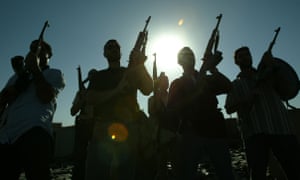
Members of the US company, Blackwater, in Baghdad, Iraq. Blackwater
became infamous in 2007 when its employees opened fire on Iraqi
civilians, killing 17. Photograph: Antonio Scorza/AFP/Getty Images
The private military and security industry is highly sensitive to criticism of this kind. The Security in Complex Environments Group
was set up to develop standards for British security companies working
abroad, and has representatives of giants in the industry such as G4S
and Olive Group, as well as the Foreign and Commonwealth Office, on its
executive committee. Its director, Brigadier Paul Gibson – former
director of counter-terrorism and UK operations – says that the private
security world has changed since the days of Iraq in 2004 and 2005, when
some companies “were operating in quite a fast and loose way”. “There
have been a number of processes to get to a position where responsible
private security companies are properly managed, properly regulated and
have human rights very much at the heart of the business model.” There
is, he says, “a huge amount going on in order to ensure that people are
operating in an appropriate, transparent manner and are accountable for
their actions.” He says this includes the International Code of Conduct for Private Security Service Providers.
But
it is voluntary. There will be some who decide not to adhere to it. How
can you govern what they do? “I can’t. You’re always going to have
rogue companies in any business sector. If a client is prepared to take a
risk by using a private security company that is not regulated, that is
a matter for the client. That is absolutely not the way British private
security companies are currently operating.” Would international
legislation not be better? “That might be something that is reached at
some point. I don’t think that is a sensible thing to do unless
everybody, globally, is doing it. There are a couple of UN working
groups looking at this issue, but they are struggling to get consensus.”
I ask him if he understands why some people find private security
companies distasteful, or even abhorrent, and he pauses. “People have
their own views. Private security companies who are operating at the
moment are providing a service to clients. Without that service, there
is a huge amount of commerce and government business that would not take
place. Private security companies are guarding British ambassadors who
are operating in very difficult parts of the world, are helping the
extractive industry to conduct their lawful business, are ensuring that
ships can go across the Indian Ocean without being interfered with by Somali pirates. I think that is all very laudable.”
John Geddes runs Ronin Concepts,
which is based, like many private security companies, in Hereford,
where the SAS has its headquarters (at least 46 firms employ former
members of the special forces, according to War on Want’s report).
He spent 22 years in the army, becoming a warrant officer in the SAS,
before a PMC in Iraq in 2003. In the dramatic opening chapter of the
book he wrote about this time, Highway to Hell, Geddes vividly describes
the time a vehicle he was in with a British news crew was about to be
targeted by insurgents in a blacked-out BMW, and he fired on the car
with his AK-47, killing the driver instantly.
His company runs some security operations, but it mainly trains
contractors, and he has seen more than 1,000 former military personnel
go through his courses. What do they have in common? “They’re pretty
much misfits who can’t or won’t fit into civilian life,” he says. They
tend to be older. “Wars are fought by 18- and 19-year-olds. The average
age [of a PMC] is mid-30s, early 40s. In some companies there is an
upper age limit of 49.” He insists it’s not really about the money.
“It’s the camaraderie, being with like-minded people, it’s the guns, the
adventure, the diverse activity. That’s why they do it.” Being in the
army, for many soldiers, becomes such a huge part of their identity and
when they leave, they are bereft. “I went through that myself. This kind
of work is therapeutic. When they’re home on leave [from a contract],
they just want to get back out there.”
Members of a private security company pose on the rooftop of a house in
Baghdad in 2007. Photograph: Patrick Baz/AFP/Getty Images
He says he doesn’t like the term mercenary. “You’re working for the
right side of the fence most of the time as a PMC. Mercenaries work for
everybody, they’ll go for the highest bidder on either side – that’s my
perception of a mercenary. The main difference is that a PMC’s role is
to protect and escape, rather than engage and attack.”
Friday
agrees, but says not every PMC – or company they work for – sees it
like that. Companies take their style and practices from the military,
but this also encourages a military attitude, he says. “They’re taking
boys out of the military and they’re used to going on active missions,
looking for trouble. They’ll still be in that offensive mindset [as a
PMC], even though they should be thinking defensively. Our job was to
defend. Say you’re a client. We get attacked, we chuck you in the
vehicle and drive off as fast as we can – that’s a successful mission.”
But the work would attract many former soldiers who want to see more
action. “It was very macho, very egotistical, and that wasn’t really my
cup of tea. Everyone had to have the latest scopes, the latest bit of
technology. There were people who just wanted to look good with their
kit.” There were contractors he describes as trigger-happy, looking for a
fight. “And essentially our job was to run the fuck away, not stay and
get in trouble. Certainly some companies were responsible for breaches
of discipline or rules of engagement [and for encouraging] an offensive
mindset, by making it so similar to the military.”
Friday gave up his job 18 months ago. He will be 40 this year, and
has spent nearly half of his life in some kind of military role, during
which he has experienced – and inflicted – acts of extreme violence. As a
private contractor, he says, “It was a good living, which set me up
nicely. Whatever the risks were, it was worth it in monetary terms.” But
there are other costs. He knew the longer he did it, one day his luck
would run out, and he became tired and disillusioned. He thought the war
should never have been started in the first place. “There are vast
amounts of money to be made from private military contracting and these
people have their political interests, same as any corporation. War is
money, war is profit.” Some names have been changed.

 Pinterest


Nenhum comentário:
Postar um comentário