'Not fit for animals' Dire conditions of Greece's first permanent refugee camps revealed Protests grow as Greece moves refugees to derelict warehouses ‘not fit for animals’
Protests grow as Greece moves refugees to derelict warehouses ‘not fit for animals’
Closure of Idomeni sees families living in military-run accommodation blocks with no running water or electricity
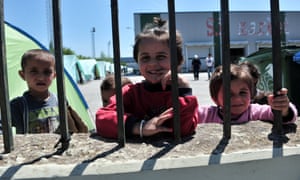
Children inside the new camp at an abandoned factory in Sindos, a suburb
of Thessaloniki, where conditions are said to be abysmal.
Photograph: Sakis Mitrolidis/AFP/Getty Images
Conditions inside a network of new permanent refugee camps in Greece
have been described as so bleak and lacking in basic amenities that they
are “not fit for animals”. Around 3,000 refugees were last week
transported to the sites after a vast makeshift camp at Idomeni, near
Greece’s border with Macedonia, was finally cleared by police.
Photographic evidence and the first accounts from volunteers allowed
inside some of the military-run accommodation blocks reveal a dire lack
of amenities such as running water, and filthy conditions in derelict
warehouses that appear unfit for habitation.
The closure of Idomeni also means that 4,000 men, women and children
remain unaccounted for following the demolition of what was Europe’s
largest makeshift refugee camp. The missing refugees, including an undefined number
of unaccompanied minors, are thought to be living on the streets of
Greek cities such as Thessaloniki, hiding in forests near the Macedonian
border or to have been taken by smugglers north into Europe.
With the border now shut, refugees heading for Europe are continuing to make the fraught journey from north Africa across the Mediterranean. Two boats capsized in a 24-hour period
off the coast of Libya last week. At least five people died, and the
Italian navy rescued 562, taking the total transferred to the country
this year to around 40,000.
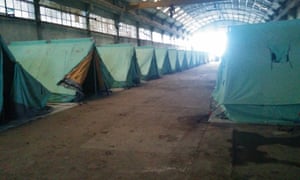
Tents are pitched on filthy concrete floors at the warehous in Sindos. Photograph: Phoebe Ramsay
On Thursday, as the Idomeni camp was officially closed, the Italian
coast guard announced it had coordinated 22 separate rescue operations
that had saved more than 4,000 lives, making it one of the busiest days
of the Mediterranean migrant crisis.
Initial reports from inside the Greek camps have prompted calls for
action. Images taken inside one new camp, in an industrial zone at
Sindos, on the outskirts of Thessaloniki, reveal dirt-strewn warehouses
lined with tents pitched on filthy concrete floors
“There was no running water, no medical care, let alone translators,
no provisions for infants, no environmental assessment, no evacuation
plan,” said Phoebe Ramsay, a volunteer who has been helping refugees in northern Greece since the start of the year. A row of tents installed to house refugees in an abandoned factory in Sindos Photograph: Phoebe Ramsay
“The conditions in the new army camps are abysmal, and range from
depressing and sterile to actually unsafe and not fit for animals,” she
said, suggesting that conditions were even worse than at Idomeni, 50
miles north.
Volunteer Alexandria South, who visited another camp set up in an old
leather factory on the outskirts of Thessaloniki, described atrocious
conditions including piles of broken glass, and warehouses with all
windows smashed.
She said: “There was no running water or showers or electricity or
firewood. Mothers had no hot water for baby formula or to sanitise
bottles, and had to use cold water.”
She said that conditions deteriorated when the Greek military, who
were overseeing the evacuation of Idomeni, ran out of water and began
ordering volunteers who were providing food and water for refugees to
feed the army first.
“The first day the army was providing limited water bottles for
families,” said South. “But on the second day there was absolutely no
water left – even with new arrivals showing up, some reporting that they
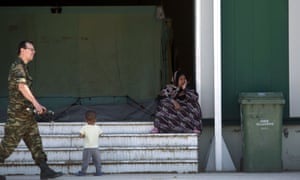
were held for three hours without water at the camp.” A woman sits on stairs inside a new camp for refugees and migrants set
in an abandoned factory in Sindos Photograph: Sakis Mitrolidis/AFP/Getty
Images
She said there were just six chemical toilets for an estimated 1,000
refugees and that no Wi-Fi had been provided, so it was impossible for
people to make asylum claims. Similarly, refugees had not even been told
where in Greece they had been relocated.
Greece’s migration spokesman, Giorgos Kyritsis, from the governing
leftist Syriza party, rejected accusations that the camps lacked basic
provisions. “There is water and electricity everywhere. One of the
reasons why we chose ex-industrial buildings instead of open-air camps
was for that very reason.
“Every time a new site is opened there are shortages in the beginning
but then we add amenities and in due process we resolve them. We’re not
saying conditions are perfect, we want to improve them but there is
absolutely no comparison between the new facilities and Idomeni. At
least now they have a roof over their head. When it rains they don’t get
wet and they’re not being forced to live in the mud. Surely that’s an
improvement?”
He denied that thousands of refugees had gone missing after the Idomeni camp had been closed.
Other charities, including Médecins Sans Frontières, have reported a number of tearful patients who had been asked to leave Idomeni without clear information on their destination.
On Friday the UN urged Greece to rapidly improve “substandard”
conditions in what it described as poorly ventilated derelict warehouses
and factories with insufficient food, water and toilets. The
International Rescue Committee has also expressed concerns. It called
for immediate action to improve standards.
Since the route north through the Balkans closed earlier this year,
an estimated 54,000 people have been stranded in overcrowded camps in
Greece. However, arrivals have fallen significantly since the European
Union’s deal with Turkey came into effect two months ago. Additional reporting by Helena Smith copy http://www.theguardian.com/international

 A row of tents installed to house refugees in an abandoned factory in Sindos Photograph: Phoebe Ramsay
 A woman sits on stairs inside a new camp for refugees and migrants set
in an abandoned factory in Sindos Photograph: Sakis Mitrolidis/AFP/Getty
Images
A woman sits on stairs inside a new camp for refugees and migrants set
in an abandoned factory in Sindos Photograph: Sakis Mitrolidis/AFP/Getty
Images


Nenhum comentário:
Postar um comentário